www.enoughproject.org
A Plan B with teeth for darfur
By John Prendergast and Colin Thomas-Jensen
Strategy Paper 2
May 2007
A Joint initiative of the International Crisis Group and the Center for American Progress
If there is a Guinness Book of World Records entry for most threats issued with no follow up, the international community’s response to Darfur is likely setting a new standard.
Barking without biting is the diplomatic equivalent of giving comfort to the enemy. In the case of Darfur, it may be even worse. Each time during the past three years that the Bush administration or the UN Security Council has threatened the Government of Sudan but failed to take action, the Khartoum regime has been emboldened to escalate its destruction and obstruction in Darfur. Its past practices make clear that the regime no longer takes these threats seriously, and will continue to flout international opinion until there are specific and escalating costs to its actions.
In these matters, it is best to rely on empirical evidence.
And the preponderance of evidence shows that during the 18 years it has been in power, the regime in Khartoum has changed its behavior only when faced with concerted international and regional pressure. Three times the regime has reversed its position on a major policy issue, and each of those three times the change resulted from intensive diplomacy backed by serious pressure—two ingredients sadly and shockingly missing from the response to Darfur today. The three cases are the regime’s support for international terrorist organizations during the early to mid 1990s; its support for slave-raiding militias in southwestern Sudan throughout the 1990s; and its prosecution of a war in southern Sudan that took two million Sudanese lives. (See “The Answer to Darfur” on www.enoughproject.org for case histories.)
When the lessons of this regime’s behavior are taken into account, the answers become clear and obvious. Continuing to ignore these historical precedents may condemn hundreds of thousands of Darfurians to death.
The necessary ingredients for the stabilization of Darfur are:
• a peace agreement that addresses the remaining issues of the non-signatory rebels and broader Darfurian society (see the new report on the peace process by the International Crisis Group at www.crisisgroup.org); and
• an effective civilian protection force, the starting
point for which is the “hybrid” AU-UN force mandated by the international community but rejected by Khartoum.
There is ongoing debate about how to secure those two critical peace and protection objectives, the first two “P’s” of what ENOUGH, a joint initiative of the International Crisis Group and the Center for American Progress to abolish genocide and mass atrocities, calls the “3Ps” of crisis response. The third P is punishment: imposing a cost for the commission of mass atrocities and building leverage through these measures for securing the peace and protection objectives.
Setting a firm deadline triggering meaningful and timely action is crucial. Last month, the U.S. accepted UN Secretary General Ban Ki-Moon’s appeal to delay U.S. and UN Security Council sanctions in order to give diplomacy more time, and the administration indicated that Khartoum would be given two to four weeks following the Secretary General’s April 2 request. A month has now passed, and, as demonstrated by recent attacks by helicopter gun ships and a build-up of Janjaweed forces in West Darfur, Khartoum continues to pursue a military solution.
Though further delay is abhorrent, there is a silver lining. The Bush administration’s current Plan B—the measures that President Bush was going to announce during his April 18 speech at the U.S. Holocaust Memorial Museum but then delayed in order to give diplomacy more time—is inadequate. In delaying implementation, the administration has given itself time to prepare a real Plan B—a set of punitive measures with teeth. Further, it gives U.S. diplomats time to use the U.S.’ month-long chairmanship of the UN Security Council (May 2007) to move Darfur high on the Council’s agenda and coordinate Plan B efforts with the European Union (which has indicated that its own Plan B sanctions could go into effect as early as June) and other international actors willing to impose a cost on the regime for its actions.
On May 18, one month after the President’s initial speech, the White House should announce a revised set of Plan B measures and allocate sufficient resources to implement them swiftly and effectively. One month is a fair amount of time after President Bush’s speech to see whether the UN Secretary General’s diplomatic efforts will have had effect. If not, then the U.S. should impose Plan B on that date and work with allies to make Plan B as multilateral as possible.
AN INADEQUATE PLAN B—SO FAR
Most of the measures the administration was prepared to announce in April lack clear and decisive plans for implementation, are too unilateral in nature, and are too weak to have a major impact on the calculations of either regime officials in Khartoum or on intransigent rebel leaders. After ten years of dealing with unilateral U.S. sanctions, the Sudanese government and its commercial partners have by now figured out how to circumvent any additional U.S. measures.
The U.S. has been blocking many Sudanese transactions since President Clinton imposed sanctions in 1997, and the Sudanese regime has had ten years to prepare for the next round. A new Sudanese oil industry has grown up around these sanctions, and the oil business is conducted without interference because this new sector is beyond the scope of existing U.S. sanctions. Though the oil industry has grown to dominate Sudan’s economy, the U.S. has little understanding of its operations, and has not committed the resources to collect such information.
Perhaps most damning, because the administration has for five months leaked information to the press about Plan B, the regime has had ample time to develop a plan for working around new, additional sanctions.
The United States cannot realistically impose robust sanctions on Khartoum unless and until it has enough information about how Sudanese business is conducted to prevent Khartoum from hiding its transactions. The U.S. should therefore undertake an “intelligence surge” by the CIA to gather detailed and comprehensive information on Sudanese companies with financial ties to the NCP and on individuals responsible for atrocities that have been or are being committed in Darfur. The U.S. should also undertake an “enforcement surge” and ensure that the Treasury Department devotes additional staff and resources to aggressively act on this new information. (As currently constituted, the Department of Treasury’s Office of Foreign Assets
Control (OFAC) cannot effectively enforce new sanctions against Khartoum without reducing its focus on other, critical sanctions regimes). Intelligence
and enforcement surges could bring the U.S. up to speed on the critical facts and capacities that are needed to effectively implement any punitive measures. And without a clear strategy of rapidly escalating pressure through a variety of economic and legal measures, then the deadly status quo will no doubt prevail.
Both of these steps require political leadership and long-term vision. Since the fall of 2001, the U.S. has counted on the cooperation of Khartoum in global
Since the fall of 2001, the U.S. has counted on the cooperation of Khartoum
in global counter-terrorism efforts and the administration continues to welcome and work closely with many of the same Sudanese intelligence officials who are responsible for Khartoum’s policies and actions in Darfur.
Members of Congress have begun to question seriously the extent of Sudan’s cooperation with the U.S. on counterterrorism matters, but stepping up the practical pressure on Khartoum may well generate opposition in the intelligence community. Similarly, the expansion of economic sanctions—particularly those that affect Sudan’s oil sector—may complicate an already complex relationship between the United States and China.
The point is not simply to punish for punishment’s sake, even though America’s signature on Genocide Convention does oblige us to punish the perpetrators of what the U.S. government has repeatedly labeled genocide. Punitive measures are necessary to gain Khartoum’s acceptance of a durable peace deal for Darfur and the deployment of an effective international force to protect civilians.
Similar measures should be imposed against leading rebel commanders and political leaders if they are deemed to have committed atrocities or are obstructing real and balanced peace efforts, which so far do not exist.
As important as it is that the U.S. act to implement a Plan B with teeth, our ability to leverage action by Khartoum will be exponentially increased if we act multilaterally. The U.S. government already has unilateral sanctions in place against Sudan that bar U.S. companies from doing business in Sudan (though allowing U.S. businesses to work with the Government of South Sudan), and freeze assets in the U.S. or in the control of U.S. citizens of the Sudanese government and certain government-owned Sudanese companies. Enacted in 1997, these sanctions did affect the calculations of the regime in the past, but they have since run their course as the Sudanese regime circumvents U.S. institutions in its commercial dealings.
Even more important, however, the fact that existing sanctions are unilateral means that Khartoum has the practical advantage of accessing non-American
financial systems and investors, and the political advantage of knowing that the international community is not acting in concert. Punitive measures applied by the international community acting as one will have a much greater impact on the pocketbooks of those responsible for crimes against humanity. Moreover, the Government of Sudan will have a much more difficult time scoring propaganda points when the U.S. is not acting alone. It is therefore critical that the U.S. works with its partners in the UN Security Council and other forums and shares both intelligence and responsibility for enforcement.
A PLAN B WITH TEETH
Financial and Legal Components
The following initiatives could be implemented immediately at little cost, but would require a strong diplomatic effort to rally multilateral support and increases in staffing and resources to ensure aggressive implementation.
• TARGET SUDANESE OFFICIALS MULTILATERALLY: Impose targeted UN Security Council sanctions—including asset freezes and travel bans—against persons responsible for crimes against humanity in Darfur. Such sanctions have been authorized in previous UNSC resolutions, and called for in multiple reports from the UNSC Sanctions Committee Panel of Experts, but they have not actually been imposed on any official of import. The U.S. effort now underway would target only three individuals,
one of whom is a rebel leader, in addition to four individuals designated in 2006, only one of whom is a regime official. The number must be much higher and be widened with each atrocity perpetrated, and reflect the reality of Khartoum’s complicity in genocide. Three senior Sudanese officials in particular must be singled out for sanctions:
Assistant to the President Nafie Ali Nafie; Director of National Intelligence Salah Abdallah Abu Digin (AKA Salah Gosh); and Minster of Defense Abdel Rahim Mohamed Hussein. These three officials maintain a tight grip on Sudan’s labyrinthine security apparatus and continue to drive policy and military operations in Darfur.
• TARGET SUDANESE COMPANIES MULTILATERALLY: Impose UN Security Council sanctions against the Sudanese companies already targeted unilaterally by the U.S., and establish a UN Panel of Experts to further investigate which companies are conducting the business necessary to underwrite Sudan’s war machine. If, ultimately the U.S. imposes unilateral sanctions on 29 more companies, this would bring the total number of companies the U.S. has unilaterally sanctioned to 159. Unless these sanctions are multilateral they will largely be meaningless, so the U.S. should lead efforts in the UN Security Council to sanction multilaterally the full panoply of 159 companies.
• PRESS INTERNATIONAL BANKS TO STOP DOING BUSINESS WITH SUDAN: As is the case with Iran, U.S. officials should engage with a number of international banking institutions to strongly encourage them to stop supporting oil transactions with Sudan, with the implication being that if such business continues then all transactions by those banks with U.S. commercial entities (and those of other countries willing to work with us) would eventually be banned. All efforts should be made to shield the Government of Southern Sudan from negative impacts from such an initiative.
This wouldn’t necessarily stop Sudan’s international exchange needs, as money would just be moved through other banking systems over which the U.S. has no access or jurisdiction, but would drive it underground and put another scarlet letter next to Sudan, furthering its isolation
and pariah status.
• REINFORCE DIVESTMENT EFFORTS: President Bush should sign an Executive Order putting into law all of the legally possible elements of existing Congressional bills in support of divestment:
the Darfur Accountability and Divestment Act of 2007 (HR 180) and the Sudan Divestment Authorization Act of 2007 (S.831). The executive branch should be supportive of efforts all over the U.S. to pressure university endowments, state and municipal pension funds, and private mutual funds to sell equity holdings in a targeted list of companies doing business with the Sudanese regime.
The Sudan Divestment Taskforce (www.sudandivestment.org) maintains an updated list of these so-called “worst offender” companies.
• SUPPORT THE ICC INDICTMENT PROCESS: Provide information and declassified intelligence to the International Criminal Court to help accelerate the process of building indictments against senior officials in the regime for their role in orchestrating mass atrocities in Darfur. The U.S. has the most such intelligence and should come to agreement with the ICC about what information to share.
A PLAN B WITH TEETH
Military Components
While the financial and legal aspects of Plan B can be implemented immediately, preparation is also required for the military elements of a Plan B with teeth. If prompt financial and legal measures succeed in altering the calculations of the regime in Khartoum, then there will be no need for these military measures. But as history makes clear, the credible threat of military action will alter the calculations of Khartoum officials. As well, and in the event the regime continues to defy its obligations to its own citizens and the will of the international community, these military actions could help to protect the people of Darfur.
Two coercive military measures require accelerated planning processes, which should commence within the NATO framework, but also seek UN Security Council approval. The aim of these military planning efforts would be to maximize the protection of Darfurian civilians and humanitarian operations if the situation continues to deteriorate.
• No Fly Zone: Absent an enhanced ground component this option is questionable and fraught with potential negative side effects. However, it is important to press ahead with planning an enforcement mechanism for a no-fly zone (NFZ) as the Sudanese regime continues to use aerial bombing as a central component of its military strategy and its civilian displacement objectives. If the mandate of the existing AU force or the planned UN/AU hybrid force would be strengthened and more troops deployed to protect civilians, neutralizing the Sudanese regime’s one tactical advantage will be essential. However, the risk to humanitarian operations posed by an NFZ must be acknowledged and mitigated. It would be irresponsible to move forward with an NFZ in the absence of preparations to deploy ground forces to protect IDP camps and humanitarian operations. Khartoum will perceive an NFZ as an act of war, so planning for a No Fly Zone must also include contingency planning based on possible responses from the Sudanese regime. The consequences could be dire. Posturing
without planning could blow up in the faces of the IDPs, refugees, and humanitarian workers bravely assisting them.
• Non-Consensual Force Deployment: Although few nations are likely to support this and volunteer forces in the present context, if the situation dramatically deteriorates in Darfur (large-scale pullout of humanitarian agencies, increasing attacks on camps or AU forces, etc.), the debate could shift quickly and credible plans need to be in place to move troops into the theater of war quickly with a primary focus on protecting vulnerable civilian populations.
This planning is both a practical necessity, and a means to build and utilize leverage against the regime.
It would be irresponsible to only pursue the implementation of a no-fly zone in the absence of any preparation for use of ground forces to protect displaced camps and humanitarian aid efforts that could be targeted as a result.
CONCLUSION
The U.S. must move away from its current policy of constructive engagement without leverage to a more muscular policy focused on walking softly and carrying—and using—a bigger stick. Unfulfilled threats and appeals should be replaced quickly with punitive measures backing a robust peace and protection initiative. We may not know the names of the victims in Darfur, but we know the names of the orchestrators of the policy that led to their deaths.
There is hope. The growing constituency in the U.S. focused on countering the atrocities in Darfur is expanding by the day. Elected officials who ignore this crescendo of activism—though not usually front page news—do so at their own peril. We will do a great service to all of history’s victims of mass atrocities if we make it politically costly for this administration, or any future one, to stand idly by while Darfur burns.
Your elected officials need to hear from you that the current Plan B proposed by President Bush is inadequate. The United States must work multilaterally
to impose punitive measures—including targeted sanctions and economic pressures—against senior Sudanese National Congress Party officials and the companies they control. By contacting your elected representatives, you will be joining thousands of concerned activists from across the country in “leading their leaders.”
ENOUGH urges activist organizations to issue action alerts urging their members to contact the White House, their Senators, and their members of Congress to press for a Plan B with teeth.
The Genocide Intervention Network operates a toll free number, 1-800-GENOCIDE that will connect you to your elected officials.
Call 1-800-GENOCIDE to contact your Senators and member of Congress and tell them:
• that punitive action against the Government of Sudan will only be effective if it is taken multilaterally;
• to urge President Bush to impose targeted UN Security Council sanctions against persons responsible for crimes against humanity in Darfur and Sudanese companies already sanctioned unilaterally by the U.S.;
• to urge President Bush to engage with a number of international banking institutions to strongly encourage them to stop supporting oil transactions
with Sudan;
• to urge President Bush to sign an Executive Order in support of divestment;
• to urge President Bush to provide information and declassified intelligence to the International Criminal Court; and
• to urge President Bush to put credible plans in place for a no-fly zone and non-consensual force deployment to protect civilians if the situation dramatically deteriorates in Darfur.
Call 1-800-GENOCIDE to contact the White House and tell President Bush:
• that Plan B will only be effective if the U.S. works multilaterally to take punitive actions against the Government of Sudan;
• to impose targeted UN Security Council sanctions against persons responsible for crimes against humanity in Darfur and Sudanese companies already
sanctioned unilaterally by the U.S.;
• to engage with a number of international banking
institutions to strongly encourage them to stop supporting oil transactions with Sudan;
• to sign an Executive Order in support of divestment;
• to provide information and declassified intelligence to the International Criminal Court; and
• to put credible plans in place for a No-Fly Zone and non-consensual force deployment to protect civilians if the situation dramatically deteriorates in Darfur.
John Prendergast is on leave from his International Crisis Group work to help build ENOUGH, which he co-chairs. His bestselling book, Not on Our Watch: The Mission to End Genocide in Darfur and Beyond (www.notonourwatchbook.org), co-authored with actor/activist Don Cheadle, is available at book stores nationwide.
Colin Thomas-Jensen is taking leave from Crisis Group work to serve as Policy Adviser to ENOUGH.
WHAT YOU CAN DO—Lead Your Leaders
The mission of ENOUGH, a joint initiative of the International Crisis Group and the Center for American Progress, is to end crimes against humanity in Darfur, northern Uganda and eastern Congo, and to prevent future mass atrocities wherever they may occur. Each month, Crisis Group’s experts on the ground assess the dynamics in northern Uganda, and eastern Congo and provide ENOUGH with comprehensive field analyses of these crises. then outlines the challenges and obstacles to policy change and offers focused policy recommendations to end these mass atrocities. The monthly updates also support an activist agenda for how concerned citizens can affect policy change. ENOUGH employs a “3P” strategy focused on promoting durable peace efforts; providing protection for the innocent victims of mass atrocities and genocide; and punishing the perpetrators to break the cycle of impunity and will utilize field analysis and policy advocacy to empower a growing activist movement for change. Working with a broad range of activists and experts with extensive experience in the field and with government, multilateral, and non-governmental organizations, ENOUGH will also issue a series of policy proposals focused on what the international community, and particularly the United States, can do now to prevent mass atrocities and genocide in the future.
ENOUGH!
1333 H Street, NW, 10th Floor
Washington, DC 20005
Phone: 202-682-1611 Fax: 202-682-1867
www.enoughproject.org
Friday, May 11, 2007
Darfur: Get Educated, Get Agitated
Find A Local Ethiopian Adoption Group
Not to dis the internet, but my recent little crisis has reminded me how important face-to-face relationships and discussions are - both for families in the process a for the kids, themselves. For all the worry I've had over children feeling comfortable being an Ethiopian adoptee in America, it seems that these meetings, where the look, feelings and experiences of fellow adoptees can be discussed in a natural, unguarded way feels like the best first step in engendering open dialog and positive self-esteem. If none of these are near where you live, you can check the Frappr map and see if anyone lives near you (add yourself while you're there) or post a message on the big group asking if others live near you. That's how our group formed with 5 or 6 families.
I posted before about the inspiring story of Nancy Meyer & her group in Chicago.
Lately, on the Yahoo! boards, some folks have been wondering how to start/join a group in their area.
That's why I'm grateful to Brian (dad of 3), fellow "SoCal Potlucker", mix-master supreme behind the awesome blog ON THE FLY and man of science for compiling pan-American information about local adoption groups (and letting me re-post it):We went to a potluck with families from our Southern California Ethiopian adoption group last weekend. Being the family that lives the farthest south, we often end up traveling the furthest to the event, but every time we attend one, I'm reminded how important it is to go. It's good for the parents to be able to talk to other families and it's good for the potential parents waiting for a referral so they can ask questions of people who've "been there; done that." Our kids are often the oldest ones there and they're not quite at the point of talking with their peers about adoption issues, but they're building friendships that will be helpful for those issues in the future. And of course its nice to (re)connect with people who's blogs you read on the internet (Blaine, Julie, and Kevin, was there anyone else that didn't out themselves to me?)So where do you find a local group? Here's a good start:
Connecticut
Rhode Island
Boston
Midatlantic: MD, VA, WVA, D.C., PA, NJ, and DE areaNew York City
loosely-defined northeastern states (New England, NY, NJ, PA etc.)
Illinois
Arizona
Northern California (SF bay area
Southern California
If I missed any groups, please add them in the comments. If you've got a blog about Ethiopian adoption, feel free to link to and/or post this list to your blog.
Thank's, Brian!
Wednesday, May 9, 2007
Now, back to our regularly scheduled program
My wife and I are grateful beyond words for the generosity of everyone who posted. Some of you we know, some we know only online, some we don't know at all. Everyone has really helped put us securely back on the path of adoption.
Here's the ingredients of the breakdown:
My parents came to town and gave a very rosey portrait of their relationship with my sister (she was adopted at 13 mos. in a closed adoption in the mid-70's). This is VERY unusual, as there has been discord between my mother and my sister since she was a preteen, which deepened into real open hostility when she was 15 through 27. She moved closer to my folks because she needed financial help, and there's been a restoration of some sort of relationship. Still, they both play massive head games and every conversation I have turns into a "he-said, she-said". So when I heard everything was good, I was hopeful. I have not spoken to my sister at length about our decision to adopt. She happened to call during this visit and I talked to her, only to learn that she has formed a very close relationship with her birth mother and views my parents as not her parents (detailed in last post), good only for financial support. While I am very happy that she's reunited with her birth mother, I am uncomfortable with the way that she is lying to/using/manipulating my parents. I am not absolving my parents, as they did everything wrong, in terms of attempting to make her a "natural" daughter by denying her her history. Add to that the fact that much of the information they DID claim to "know" about her past is being disputed by the birth mother. I personally think EVERYONE involved is lying and trying to make themselves look good. Still, it's been pretty heartbreaking to be in the middle of what should be a happy and hopeful journey towards adoption and yet be in the middle of this ready-for-Jerry Springer drama, in which you are informed that your family was not "real" and was "abusive", and that the birth family is "real".
Only in that moment did I begin to understand what it must be like (on all sides) for an international adoptee to feel that he or she would rather have grown up an orphan in his or her native country than be adopted.
At the same time, my wife's mother, who is, frankly, a really amazing person, had a breakdown in her support. She's afraid of us traveling (we entered into the adoption with the intention of escorting, but have become convinced of the necessity of traveling). This spun out into an expression of many, many doubts and fears -- some legitimate, but many the kind of uneducated fears fostered by the mainstream media's shallow and sensationalistic coverage of adoption in general and international adoption in particular. It's important that I make it clear that none of this was based on race, but rather issues about bonding, corruption, mental illness and health history and the ethics of adoption agencies.
My wife is incredibly close to her mom and, even though my wife could argue against most of her mother's fears, the emotional toll of worrying her was very great. It eroded her confidence in the decision. More importantly, I think it made her feel that by pressing forward, she would be betraying her mom on some level. Add to that the fact that we have very little-to-no family or family support. She's the only person we have locally, and knowing that she's not supportive weighs on us.
The two events tapped into all of the reading we've done about first world "baby buying" and adult adoptee resentment, creating a perfect storm of doubt. We almost emailed our agency and told them that we were done.
So, that's the backstory. Now, thanks to your kindness, we've rediscovered our initial enthusiasm.
Here's what helped:
Brian (dad to 3) said...
Then again, many parent/child relationships are strained and many times it's the parents' fault, so I figure I have quite a bit of control over them not hating me and it's far from "nothing more than a gamble".
A woman from our agency, who's also the mother of many adoptees, some who've reached adulthood, and a few who are Ethiopian, said much the same thing -- that the method of parenting adoptive children has evolved tremendously in the last 30 years. Either through their own selfishness or through the legitimate fact that adoption was treated differently at the time, my parents basically made all the "wrong" choices in parenting my sister... and got a predictable result. You, this adoptive mother and others have pointed out that, while no guarantee, more enlightened, less selfish, more honest parenting can help make adoption seem more normal.
Jon said...
You may have already stumbled upon this, but here's a great blog written by an adoptive mom of two korean born children.
www.thirdmom.blogspot.com
I do read her often. Thank you for pointing out her most recent posts.
-Samantha- said...
Wow, what happened my friend? To tell you the truth, it seems to me that you think way too much. You are overanalizing everything... For all you know, your adopted child will become the one you are most compatible with...who knows.
Certainly, it has not been blood that has fostered my best relationships. To be honest, I am somewhat envious of many of the people in the ET adoption community who blog about their close relationships with family. I have an incredibly perfunctory relationship with my blood relatives. There's every possibility that the same deep connection I have with my best friends could also be forged between me and my daughter -- let's hope so!
Anonymous said...
I have felt very similar to what you wrote about, I have been on the other side of being the adopted child and "hating" my adoptive father at the time, now we have a really good relationship, and he is dear to me.
-Emmelia
www.corban7@wordpress.com
I know that becoming an individual is the point of childhood, and a natural part of that is a pulling away from the parents. I fully expect all my kids to go through a period where they pull away and reject. I think what freaks me out about my sister is that she's in her early thirties and has 3 kids of her own. It's nice to hear that not all rifts are permanent.
Anonymous said...
I've noticed that many of the adult adoptees (domestic) are in closed situations, or come from really abusive families. I feel more readily able to dismiss those situations as being too out of the norm to be relevant background for my situation. However, I think we have a lot to learn from the stories if we can sift through the anger (get ready for a wild ride). We have as much to learn from international adoptess who are coming of age.
So, the bigger question for me is: what can we learn and do differenly based on their experiences. I've got a long way to go on my learning curve, but so far I've decided:
1) I need to do more work integrating culture into my children's lives...more openness and communication will be necessary. It's going to be WORK, lots of work for me. I may have to move to a different neighborhood, go to a different church, find new physicians, and definitely surround my family with people "like" my kids.
2) Adoption reform, especially for domestic adoption, is needed.
3) Socioeconomic reform is desperately needed on a global scale. Read "The End of Povery" if you disagree. Such reform could result in a huge reduction in the availability of children for international adoption. Sucks for me personally, but I would get up on a table and shout 'hallelujah' if I knew that fewer people in the world were dying from lack of access to clean water or basic medication, that more families could afford to raise their children.
All of the above, I feel, is dead on. As most readers know, I've recommended THE END OF POVERTY highly a few times. It was a transformative book for me, paving the way to choosing Ethiopia over other programs -- long before we seriously considered adoption.
I try to incorporate economic justice into this blog as much as possible without having it overwhelm the focus on adoption, itself.
Anonymous continues, saying:
One of the biggest "catch 22" issues for me is that many Ethiopian children are not "orphans" by my standards: they have families, often families they know, who could and would want to raise them if those families had the cash OR in some circumstances if AIDS (b/c of death of one or both parents) wasn't such a social stigma. How do I reconcile that my children have living relatives who love them, but because of a long history of social, economic and political development, CAN'T raise them. So, then I fly halfway around the world to take them out of the only life they know and raise them as my own? And I know this is true because I get the chance to meet these relatives before I leave the country and give them a nifty map of where we'll be (as if they'll ever get to visit) and a generic photo of our "family"?
This weighs on me as well. I think I entered the process thinking of "orphans", and coming to understand that most are relinquished. In my posts about birthmothers, I've discussed how this has thrown me for a loop.
I read once that for some adoptees, the trauma of adoption is distinct from the event of getting a new family. In other words, adoption does not cause relinquishment. The relinquishment and trauma would occur anyway.
It's important, I think, to run a check on the idea that you are "saving" anyone. I feel that having selfish motives -- WANTING a daughter, ENJOYING Ethiopian culture, in my case, actually HELPS motivate me to do the RIGHT THING by my daughter and keep her culture and heritage alive.
As for "orphanage vs. family" and the disruption to culture and language...
Umm 'Skandar said...
What is the greater loss, to lose one's country, language, and culture? Or to have no family? It seems that right way to balance anger adult adoptee question is to seek out adults who lived their whole life in an orphanage. What can they add to this conversation?
I agree -- does anyone know if orphans have ever gone on record??
Carrie said...
My friend, I know exactly were you are in your adoption journey right now. The fear that you feel is real and you have real reasons to be afraid. Adoption, like everything in life, comes with no guarantees. You may adopt a child who has very real issues with being adopted or you may adopt a child who has none. Have you read “In Their Own Voices” by Rita Simmons? I found it to be a very realistic look at how transracially adopted children feel about their adoption and being raised in a white family. Many of these children had to deal with issues stemming from their adoption, but most still felt close to their adoptive parents. The people who had the most issues with their adoptive parents seemed to be the ones where there was “other”
issues with the child/parent relationship besides adoption e.g., abuse, neglect, poor communication.
I have not read this book yet, but was aware of it. I'll have to order it.
This post heartened me because the idea that adoption is a complication in an otherwise dysfunctional parent/child relationship applied to my parents and sister's relationship. Many of their parenting choices didn't have great results for either my sister or me -- but with adoption adding an extra wrinkle, her problems with them are more pronounced than mine. Once again, hopefully more selfless parenting can lead to a more healthy, respectful relationship all around.
Cathy and Abebech said similar things...
cathy said...
You wouldn't be a good parent if you didn't wrestle with these questions.
abebech said...
These are great responses. Please do check out thirdmom's blog, and my own post in response.
I am pro-adoption reform, pro-open records, do believe that children are best served by being raised in healthy families of origin, yet I feel very passionately that we did the right thing by our daughter, and will do so again by another child BECAUSE we've considered all these angles, listened to those very important voices, gave it all serious consideration and decided as we did. I also realize that doesn't mean she'll think we did the right thing when she's old enough to decide. But she'll know we did what we believed was the best thing, with our hearts full of love for her. Isn't that what most parents do?
A surprisingly cogent and effective argument. Also used by our African-American social worker, when I pestered her with questions during our home study. I may actually start believing it!
For those not in the know, Abebech is A NEW FLOWER BLOOMS. I have blogged about her awesomeness before.
jen said...
One thing I have considered, along with a lot of what has already been said here is that our children will grow up in a very different world than the adopted children coming of age. There are gazillions of books for us parents to read, there are studies that show what worked and what didn't, there are many more adoption communities and support groups, there are even more inter-racial relationships (marriages, adoptions, etc.) than twenty years ago. That's not to say that we have come so far that we don't need to work HARD, but it is to say that our children will have a different background than the children who are adult adoptees now.
Julie said...
I think the anger many adult adoptees have is a result of a line of thinking their parents' generation had toward international adoption (and adoption in general). Adoptive parents did not try (for the most part) to include their children's culture and did not address the issue of race. Some adoptees were even made to feel grateful for being "rescued" by their parents. Of course these are all generalizations, but awareness of the importance of one's birth culture and race are things that we as adoptive parents are only now starting to deal with in a healthy and constructive way. My thought (and hope) is the newest generation of adoptees will not be as angry as some of the current adult adoptees.
My wife and I attended a gathering of other adoptive families this past weekend. It was really amazing. It felt so natural, and the families were all really wonderful. I think these resources and the increasing awareness of adoption will help kids feel more "normal".
I must also say that part of my wife and my reason for continuing is all of you. We've met some of the most engaged, open, honest, decent people within this adoption community. People who are engaged in the world, people who are fighting for economic justice and racial equality. People who's relationship with God is about love and community, not division or oppression. People willing to admit to fears, mistakes and insecurities.
It may sound strange, but we figure such people can't be involved in something wrong, or something damaging to kids.
So, we're soldiering on, waiting for our referral. I'll continue to blog about race and culture and adoption, in hopes that such an education can making me a better parent -- and that by being such a parent, I really can tip the scales of fate in my (and my adopted child's) favor.
Mother's Day Gifts That Help UNICEF
Send Hallmark UNICEF bouquets this Mother's Day and Hallmark will donate 5% of the purchase price to help UNICEF immunize children against life threatening diseases. Choose from the "Everyday Miracles" bouquet featuring roses and sunflowers or the "Beautiful Spirit" bouquet featuring light and dark lavender roses.
Pier 1 Imports is offering a gift idea with a rhythmic twist. Gratitude, Life & Love is a compilation CD of inspirational songs paying tribute to the special bond between mother and child. 25% of the purchase price (less tax) will go toward UNICEF's efforts to build a better world for women and children. Available in Pier 1 & Pier 1 Kids stores and pier1.com.
Honor her with a distinctive gift to celebrate Mother's Day. For a contribution of $25 or more in honor of the recipient, you can send a message of love and appreciation and help UNICEF create a world fit for children! Visit unicefusa.org/tribute to learn more.
Tuesday, May 8, 2007
Confused, Need Help
HEEEEEELLLLLLPPPP!
For people who have OLDER ADOPTED KIDS and for ADULT ADOPTEES... I'm having real problems coming to grips with the idea of adoption -- how does an adopted person integrate her adopted family with her birth family. Does an adopted person ever get over that dissonance of coming from somewhere else -- and in this case another culture (which the child will, on some level, lose) and another race (which the child, on some level, will feel alienated from)and a birth mother a half-a-globe away, more imagined to her than real.
I've gotten so far into the experience of adult adoptees who feel "completed" by their birthfamily (some who are still on good terms with the adopted family, most who are not), that I'm beginning to feel that adoption is nothing more than a gamble.
I have a tremendous capacity to love an adopted child as my own. I have energy to do my best to compensate for not being raised Ethiopian, or even in an African-American family. I have energy to try to help, in my small way, to make Ethiopia better.
What I do not have the capacity for is to have the relationship with an adult child that I see many adult adoptees and their families having. I am so freaked about it that I feel it may be better not to "risk" the "experiment" of adoption at all.
I'm starting to side with the anti-adoption crowd. Their arguements are really starting to make sense. I'm even questioning the desire to have a third child by any means -- my wife and my unwillingness to play genetic roulette by getting pregnant over 35 was a major factor in chosing adoption in the first place.
Am I chicken? Am I having cold feet? Do I have a statistically skewed view of adoption? Or am I just being honest that I don't want to risk endangering my marriage and my bio kids' lives for a potentially bad outcome?
Friday, May 4, 2007
Obama Brings Out the Racists
This is not a political endorsement, but I REALLLLLLY want Obama to get the Democratic nomination, because then we will see, very clearly, EXACTLY how far we've come since the '50's. And I bet it isn't that far.
Racism is less tolerable in polite society, but with the internet there to mask identities, people are free to post their REAL opinions on CBS' comments.
Obama is also requesting Secret Service protection earlier than any other candidate ever. Hmmmm, what's different about him, compared with the nearly 20 other Republican and Democratic nominees?
Get ready to be proud of America, folks:
May 4, 2007
CBSNews.com Turns Off Comments on Obama Stories
Posted by Brian Montopoli
(AP Photo)
Today CBSNews.com informed its staff via email that they should no longer enable comments on stories about presidential candidate Barack Obama. The reason for the new policy, according to the email, is that stories about Obama have been attracting too many racist comments.
"It's very simple," Mike Sims, director of News and Operations for CBSNews.com, told me. "We have our Rules of Engagement. They prohibit personal attacks, especially racist attacks. Stories about Obama have been problematic, and we won't tolerate it."
CBSNews.com does sometimes delete comments on an individual basis, but Sims said that was not sufficient in the case of Obama stories due to "the volume and the persistence" of the objectionable comments.
There has been a fierce debate about how news outlets should handle reader comments. Washingtonpost.com's Jim Brady, whose site, like CBSNews.com, does not have the resources to filter comments in advance, told Howard Kurtz that he'd "rather figure out a way to do it better than not to do it at all."
But Post reporter Darryl Fears told Kurtz that comments should be eliminated if they can't be pre-screened for offensiveness.
"If you're an African American and you read about someone being called a porch monkey, that overrides any positive thing that you would read in the comments," he said.
CBSNews.com has no plans to disable comments on stories about the other presidential candidates, according to Sims. As for comments on Obama stories, he said the site is open to eventually bringing them back.
"We'd like to be able to return to them, and I'm not ruling that out," said Sims. "But at this point it's not possible."
Thanks to Skeptical Brotha for the heads up.
ONE: Feinstein-Hagel Letter Closes with 55 Signatures
Feinstein-Hagel Letter Closes with 55 Signatures
Thanks from me to any and all who participated.
Thursday, May 3, 2007
Make Mother's Day Extra Happy
Use your Mother's Day present to help mothers you've never met! The links below will take you to catalogs which allow you to buy gifts that help others, the purchase of which directly help international aid organizations at work in Africa. All the charities listed in this post have gotten an "A" rating from the American Institute of Philanthropy (charitywatch.org), indicating that over 90% of their budget goes to relief work. In addition to supporting charities (or, in the case of ONE, an advocacy campaign), many of these products are FAIR TRADE or the handiwork of impoverished people. By purchasing from most of these sites, you are "giving" two times over: helping individuals directly and supporting a relief organization.
If you have a mom (or wife) who says "It's the thought that counts" and MEANS IT, try one of the choices below. These links also take you to places to buy gifts online which support "A"-rated relief organizations. In the cases below, however, the "gift" is really a personalized donation, which allows you to give the intended recipient of your gift a card stating that you bought school supplies for a classroom, or food rations or courses of AIDS drugs in the name of the recipient. Unlike raw donations, the amounts correlate to a specific usage, making the gift more "tangible" and meaningful.
Happy Mother's Day!
Blogroll Update
Welcome the new members of the Swerl family!
Get a Free Professional Portrait!
I learned of this from "Tamra" on a Yahoo! board.
There is a group of affiliated photographers, called CELEBRATING ADOPTION. They offer a COMPLIMENTARY SITTING FEE for a professionally-shot portrait of your adoptive family IF YOU'VE ADOPTED IN THE LAST YEAR.
Use their website to find a photographer in your area!
Uganda
Swerl reader, Sonora has TWO globe-trotting photographer brothers, both active in Africa.
Her brother IRA LIPPKE's page has tremendous pictures of UGANDA. Because it's all flash navigation, I can't link you to it. Get past the splash page, then CLICK ON HIS NAME (on the left) and chose "Uganda".
Her other brother, SAMUEL LIPPKE's personal blog,"When does this boat dock?" has fantastic pictures and information about rallies to end the war in Uganda.
His PORTFOLIO also boasts amazing pictures of Uganda, mixed in with others. Click "Menu" and choose "World".
Thanks, Sonora, for sharing!
Africa News Round-Up
Progress on Punishing Those Responsible for the Genocide in Darfur:
(AP)The International Criminal Court has issued arrest warrants for the Sudanese government’s humanitarian affairs minister and a janjaweed militia leader suspected of committing war crimes in Darfur, the court said Wednesday.
Ethiopia and Press Freedom:
(AP)Ethiopia tops a list of 10 countries — including three in sub-Saharan Africa — where press freedom has deteriorated over the past five years, a New York-based media advocacy group said Wednesday.
Three countries on the list — Ethiopia, Gambia and Congo — show that "democracy's foothold in Africa is shallow when it comes to press freedom. These three African nations, as diverse as they are, have won praise at times for their transition to democracy — but they are actually moving in reverse on press issues. Journalists in Ethiopia, Gambia, and DRC (Congo) are being jailed, attacked, and censored, a picture far worse than what we saw only a few years ago."
Ethiopia's Internet Repression
(Reuters) An Internet watchdog on Tuesday accused Ethiopia of blocking scores of anti-government Web sites and millions of Weblogs in one of sub-Saharan Africa's biggest cases of cyber-censorship.
SIGN THIS PETITION TO HELP FORCE AMERICAN COMPANIES TO STAND UP TO REPRESSIVE REGIMES. Google and other American companies allow Ethiopia and China to "block" blogs and webpages, in order to profit in these countries. If we are in the business of spreading democracy (and if Ethiopia is really our ally in the war against the anti-democratic terrorist ideology), we should encourage American companies to show, by example, how integral the "Fourth Estate" is to the democratic system.
Starbucks, Ethiopia, Strike Deal
Starbucks and the Ethiopian government agreed in principle on a licensing, distribution and marketing deal that recognizes the importance and integrity of the nation's specialty coffee names, they said in [a joint] statement.
The parties expect to formalize the details of the agreement and sign it this month.
"Ethiopia is firmly committed to work in partnership with all international specialty coffee companies and distributors of its fine coffees, including Harar, Sidamo and Yirgacheffe," said Getachew Mengistie, director general of the Ethiopian Intellectual Property Office.
Aid agency Oxfam, which launched an campaign in October last year urging Starbucks to talk to Ethiopia directly on the issue, welcomed the move.
"This initiative will help create real change for the 15 million Ethiopians dependent on the country's coffee sector," Oxfam America President Raymond Offenheiser said.
Poverty is dire in Ethiopia, where a quarter of its 80 million people rely on coffee. The average Ethiopian's yearly income, in purchasing power parity terms, is around $1,000.
Eight Ethiopian Hostages Free
Eight Ethiopians made a tearful return to Addis Ababa on Thursday, two months after being kidnapped at gunpoint with five Europeans in the country's remote northeastern Afar region.
Wednesday, May 2, 2007
Honesty
Honesty is the best policy -- especially in adoption. I got another lesson in that this weekend. As I've been reading and mulling over our own adoption, I've been thinking about my sister (an adult adoptee from a closed, domestic adoption in the '70's). My parents happened to visit (a rare occurrance as there's a continent in between us). They were telling me that my sister, after being reunited with her birth mother a few years ago, had stopped contacting her.
It happened that my sister called during the visit. I was interested to talk to her about her feelings on adoption. Before I could even ask a question, I was surprised that she offered that she was in weekly contact with her birthmother, but did not want to tell my parents. My heart sank immediately. The lies and deception (going in both directions) which have defined her relationship with my parents had not gone anywhere. Unwilling to resume my teenage role as the person caught in the middle, I told her that while I supported her connection with her birthmother, I didn't want to keep her secrets.
She continued, telling me that was resentful that our parents didn't welcome the relationship, and that her birthmother had been writing letters (never given to my sister) since my sister was 13. I remember the letters and the chaos they caused. I also remember that my parents did not share the information with my sister and, instead, told the birthmother to respect our family.
While my parents constantly told her she was adopted, they also went to great lengths, mostly motivated by their own ego, to prevent her from discovering or exploring her own biological origins. Since she was constantly told that she is not bio, (which is fine), but NOT allowed to discover her biological family, then, I feel, she was put in a position of always feelling "less than". These are my feelings, not hers.
I was 17 and about to go to college when the first letter came. I thought at the time that the letter was HERS and that it was, at best, a mistake and, at worst, a cruelty not to give it to her.
At the same time, I understand my parents motivation -- to be THE PARENTS. Especially now, I "get" that impulse. However, for the good of the child, that impulse should be fought against, and, as an adoptive parent, you must fight to have your heart open to another family, for the good of the child. My parents are still fundamentally incapable of this, seeing any relationship with the bio family as a betrayal and a sign of disrespect.
Adoption or no, they are big on blind obedience. Tragically, the more they pushed, the more our family deteriorated.
Throughout her childhood and teen years, my sister caused a tremendous amount of havok, each year of her life more disruptive than the one before, locking horns with my parents in a battle of wills that continues to this day, when everyone is definitely old enough to know better.
My sister told me that, although she well remembers her life-book (which did not mention anything prior to her adoption into our family), and knew she was adopted, she didn't "get it" until a science class in Jr. High, in which she learned, "about the x-chromosome and the y-chromosome and all that stuff" (to use her words). "That's when I realized -- I don't have anything to do with these people." These people being my parents.
She never mentioned this at the time, as I recall, but, evidently, this was an element in her pulling away, as she tells it now.
I entered into the conversation with a Pollyanna-ish view that, somehow, I could use the knowledge I've been trying to amass to help "fix" my family's situation. My nascent idea smacked up against reality. For the reasons above and others I choose not to share (having little to do with the adoption), I realize this is not possible, and any attempt will only result in me and my family being dragged into their dysfunctional relationship -- smashing through years of carefully-structured boundaries.
This situation factored into my initial reluctance to adopt. It also entirely motivates this blog. With the help of my wife, I've realized that I cannot undo the past. What I need to do is convince myself that, through more honest and empthathetic parenting, I can AVOID REPEATING THE PAST.
I'm at a bit of a low ebb. I'm hoping this launches a lively discussion between ADOPTEES and ADOPTING FAMILIES. I really look forward to anyone else's experiences and insights.
Monday, April 30, 2007
Don Cheadle on Darfur: "And Now What?"
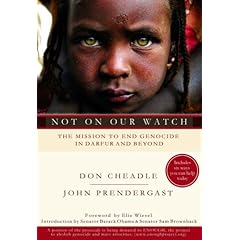 Darfur is Rwanda in slow motion. Darfur has time that Rwanda did not. America can make the difference. WE can make America make the difference.
That’s the message Don Cheadle and John Prendergast recently imparted at a lecture I attended, adding urgency and up-to-the-minute information to the passion expressed in their book, NOT ON OUR WATCH: THE MISSION TO END GENOCIDE IN DARFUR AND BEYOND
Don Cheadle, fresh from his role in HOTEL RWANDA, had heard about Darfur from Congressman Ed Royce (R-CA). A short time later, he met John Prendergast at a screening of the film, hosted by the New York Holocaust Museum. In 2005, NIGHTLINE captured Mr. Cheadle's journey to the camps in Chad, and the burned 1,500 villages in Darfur. The experience left him humbled, but he also felt it would be the height of hypocrisy to declare the platitudes of "Never Again" during the promotion of HOTEL RWANDA, but not do everything in his power to stop the killing in Darfur.
"If you're a parent, like I am, to see the children that are suffering as a result of what's happening in that region and also, finding yourself in a place where you can't believe you knew so little about, where so much is happening... It just struck a chord in me and touched a nerve that it's hard for me to do anything but ask myself afterward, "And now what? You've seen it, you know it, you've confirmed it, and now what?"
That lingering question led NOT ON OUR WATCH: THE MISSION TO END GENOCIDE IN DARFUR AND BEYOND, a book authored by the actor and Prendergast, a senior advisor to the International Crisis Group, an organizer of Enough! The Project to Abolish Genocide and Mass Atrocities and a former director of African affairs for the National Security Council (1996-99) and a special adviser to the State Department (1999-01). Prendergast has been working to end crises in Africa for 23 years.
Prendergast described Darfur as "Rwanda in slow motion". "In Rwanda, within 100 days, 800,000 lives were extinguished. Those people can't be brought back... Here in Darfur, it's going on NOW. It's a race between the killers in Khartoum and those who would intervene and stop the killing." Prendergast noted, sadly that during the entire 100 days of the Rwandan genocide, the US government didn't receive one letter from an American citizen, urging action. This time, he points out, is different. The crisis is moving slowly enough, and, "for whatever reason", Darfur has captured the imagination of the average citizen in such a way that it IS becoming a political issue. These two factors give Prendergast and others in the human rights community hope.
As Prendergast explains it, after years of brutal political repression from Khartoum, non-Arabs living in the Darfur region of Sudan began a small guerrilla war to fight for political representation. They successfully attacked about 30 Police and Army outposts in the region. Rather than engage with the guerrilla militias, Khartoum "contracted out" to the Janjaweed, a militia Prendergast describes as a Sudanese "Ku Klux Klan" -- a racially motivated, armed "lynch mob", essentially. The Janjaweed practices a slash and burn warfare against villagers, figuring if they kill or displace anyone who can give material support to the rebels, the rebellion will dry up. In the ensuing years, 1,500 villages were razed, 400,000 people were killed and millions were displaced, mostly to NGO-supported refugee camps in neighboring Chad.
"Phase Two" of the Janjaweed assault consists of attacking African Union Peacekeepers and NGOs (charities like Mercy Corp., Red Cross, Doctors Without Borders, etc.), forcing them to pull out of the region, leaving the refugees abandoned and vulnerable. It is in the face of this mounting crisis, this attempted genocide against those who survived the first pogrom that requires stronger international intervention.
So far, the White House has offered a very mixed bag: Bush has rightfully called the crisis in Darfur a "genocide", but then has failed to take the next step, required by the Genocide Convention, signed after WWII, to take swift action to prevent the genocide and punish those responsible. Prendergast explains that while the US has provided funds and material support in the form of humanitarian aid to the refugees, it has refused to impose any real consequences on the Sudanese government.
The reasons are simple. First, Khartoum feels that by hiding behind the extra-governmental actors, the Janjaweed, it has plausible deniability. Second, after spending decades helping Osama Bin Laden, Sudan suddenly switched sides shortly after 9/11, becoming an "ally" on the war on terror. According to Prendergast, Sudan has vast intelligence on the financial structuring of Al Quaeda, and they are withholding that information from the US -- dangling it in front of our noses, as it were -- to provide themselves with an insurance policy against international interference. "Every time the US is about to get tough, Khartoum 'happens' to find another file." Finally, China is the major investor in Sudan and the biggest customer for Sudan's oil. To sanction Sudan would be to confront the Chinese, something few in Bush's inner circle wish to do. Prendergast insists that China is, in essence, "financially supporting genocide".
To answer criticism that the UN is obstructing the US on this issue, Prendergast pointed out that China has never once exercised it's veto power on the Security Council over a human rights issue. While everyone acknowledges that China is no champion of human rights, to put it mildly, they also don't want to be isolated as the only country publicly DEFENDING genocide. It is Prendergast's considered opinion, that with the US and Britain in lockstep, we could back China into a corner, essentially shaming China into going along with sanctions.
How do we move President Bush? This is the most interesting part of the lecture -- and, interestingly, due to it's timeliness, the part not covered in the book:
Don Cheadle exclaimed, "There is a decision being made very quickly. There's a way to make your voice heard while there's something that is pending." Prendergast elaborated: "The President has on his desk, or is about to get on his desk, very soon, something he's asked for. He said, ‘We are not doing enough to end this genocide.’ He's using this word, ‘genocide’, the first time a President has ever called a genocide by it's rightful name while it was ongoing. President Clinton didn't do it in '94 in Rwanda, famously using all kinds of verbal gymnastics, trying to circumvent what was believed to be a legal obligation, then, to act. President Bush, remarkably and courageously, used this term. Everyone thought it implied that he would act [due to the requirements of the Genocide Convention], then [Bush] didn't..."
Now, after mounting political pressure, especially from Christian and Jewish conservatives -- members of his base, Bush has asked for recommendations from National Security Advisor Steve Hadley. Those recommendations either have been or are soon to be delivered. The recommendations could range from instituting an arms embargo, freezing assets or travel bans that would restrict the movement of senior Sudanese officials. Other recommendations could include sending in more African Union Peacekeepers (ironically, including troops from a now peaceful Rwanda) or more UN Peacekeepers. Not even advocates like Prendergast believe it is in anyone's best interest to commit American troops.
This brings us full circle, to Mr. Cheadle's stark, honest question: AND WHAT NOW?
Relying on his own experience in the halls of government, Prendergast shared his plan of action, "Make some noise. Demand from your elected officials that they make this issue a priority and that they press the President of the Unites States to do so, to take the lead in undertaking the kinds of actions necessary within the international system and we can end this genocide very very quickly.
There's no K-Street lobbying firm advocating for genocide and crimes against humanity. It's in our hands. We don't have an opposition -- it's just inertia and indifference and ignorance that are our enemies on this issue.
From the experience I've had, [calling/writing/emailing/demonstrating] DOES make a difference. When a member of Congress or a Senator or the White House gets a slew of letters or emails or phonecalls, demanding action, they will respond. That's the way our system works."
For more great information on how to effectively work to end genocide, buy "Not On Our Watch: The Mission to End Genocide in Darfur and Beyond" by Don Cheadle and John Prendergast. The book includes a thorough history of the Darfur genocide, Northern Uganda, Congo and (as those involved in Ethiopian adoptions are aware) Somalia. The book includes SIX INSPIRING WAYS TO ACT, three ways to stop genocide, a profile of "upstanders" -- normal citizens who are making a difference through creativity, and a HOST of incredibly valuable tips about how to effectively advocate (which would be useful for ANY kind of activism). The book also contains many emotional stories of the crisis and lots of first-person reporting by Don Cheadle as he canvases the globe in hopes that he can make his pledge "Never again" a reality.
SwerlAction:
Call The White House comment line this week, to demand stiff sanctions against the Sudanese government.
Here's the number -- (202) 456-1414
Talking Points (courtesy of www.savedarfur.org):
I'm calling because I am concerned about the violence in Darfur, Sudan.
I urge President Bush to implement "Plan B" without further delay.
Nearly two months have passed since the President's January 1st deadline for the Sudan to cooperate - it's time to act.
While calls are best, you can ALSO email the White House and UN Secretary-General Ban Ki-moon, urging them to take stronger action. The message will read:Every day, the 2.5 million people chased from their homes in Darfur face the threat of starvation, disease, and rape, while the few lucky enough to remain in their homes risk displacement, torture, and murder. Therefore, I call on you to do the following:
Other resources:
1. Push for the immediate deployment of the already-authorized UN peacekeeping force.
2. Strengthen the understaffed African Union force already in Darfur until the UN force can be deployed.
3. Implement a fair and lasting Peace Agreement.
4. Increase humanitarian aid and ensure access for delivery.
SAVE DARFUR/Global Days for Darfur
Enough! The Project to Abolish Genocide and Mass Atrocities
www.sudandivestment.org - if you are part of any kind of mutual fund or pension fund, contact the mutual fund or pension fund manager and request that the fund DIVESTS ITSELF OF ANY SUDANESE INVESTMENTS. This kind of economic boycott helped bring an end to Apartheid.
Making China accountable Buy HOTEL RWANDA
earth.google.com - Download Google Earth, find and click on Darfur to see an amazing presentation that gives you the reality of the situation through a massive on-line exhibit.

Introducing SwerlAction!
We are a dream constituency. We are, for the most part, pretty well-off, responsible citizens, spread out all over the country, in all different districts, in different faith communities, of all different races and backgrounds. Yet, due to the miracle of adoption, we care about ending extreme poverty on a continent still coping with the legacy of actual imperialism and economic imperialism.
We are all agents for change. There IS NO ONE BETTER THAN US. We aren't neo-hippie college students or professional activists. WE ARE THE AVERAGE FOLK -- except for one fact: how we are expanding our family, and the cultural and political awakening that brings.
I've been increasingly motivated to take my commitment to Africa seriously -- to try to give back as much as I can, in return for what Africa is entrusting to me.
I'm also trying to keep this here blog clean and readable. Sometimes, as new posts get added, important ideas get buried.
I've avoided expandable posts for activism, trying to make sure it all gets read, but it's gumming up the works.
The solution is SwerlAction, a new link list at the upper left-hand side of the blog. Before surfing your friends' blogs, take a moment to peruse.
The rules of SwerlAction are simple: ONLY TIME REQUIREMENTS, NO CASH REQUIREMENTS.
THERE WILL NEVER BE ANY SOLICITATIONS FOR DONATIONS.
No lists of non-profits, no "cause marketing", no "fair trade catalogs".
It will be:
EMAIL CAMPAIGNS
CALLING CAMPAIGNS
ONLINE PETITIONS
ADVOCACY GROUP MEMBERSHIP DRIVES (NO COST, NO CHARITIES)
NO-COST-TO-YOU, "CLICK"-BASED FUNDRAISING.
It will work to end extreme poverty and attendant problems in AFRICA.
This keeps everything nice and clean. I will keep on top of it to try to keep it current.
If you have any ideas that MEET THE ABOVE REQUIREMENTS, please EMAIL ME.
Let's be the best darn motley crew of advocates for Africa we can be.
Saturday, April 28, 2007
Darfur Days
On Friday, I heard an inspiring lecture by John Prendergast (International Crisis Group/www.enoughproject.org) and actor Don Cheadle on the genocide in Darfur.
I will have a proper post on Monday regarding the lecture, but that will be too late to urge everyone to attend a rally on Sunday (tomorrow). This is a crucial moment. President Bush has declared the crisis a "genocide", but has failed to live up to the International Genocide Convention, signed after WWII. His staff has recommended stiff sanctions against the Sudanese government, but Cheney and other members of his Cabinet are arguing against implimentation for various political reasons, including Sudan's intelligence capabilities against terrorists and maintaining good relations with China.
It could either way. Only popular pressure can encourage Bush to make the moral choice rather than the politically-expediant choice.
Attend a rally tomorrow (Sunday, April 29th). Go to SAVE DARFUR/Global Days for Darfur for information on rallies in your area. You can enter your zip code to pull up that information.
Also, if you cannot attend a rally, call The White House comment line this week, to demand stiff sanctions against the Sudanese government.
Here's the number -- (202) 456-1414
Talking Points (courtesy of www.savedarfur.org):
I'm calling because I am concerned about the violence in Darfur, Sudan.
I urge President Bush to implement "Plan B" without further delay.
Nearly two months have passed since the President's January 1st deadline for the Sudan to cooperate - it's time to act.
While calls are best, you can ALSO email the White House and UN Secretary-General Ban Ki-moon, urging them to take stronger action. The message will read:Every day, the 2.5 million people chased from their homes in Darfur face the threat of starvation, disease, and rape, while the few lucky enough to remain in their homes risk displacement, torture, and murder. Therefore, I call on you to do the following:
1. Push for the immediate deployment of the already-authorized UN peacekeeping force.
2. Strengthen the understaffed African Union force already in Darfur until the UN force can be deployed.
3. Implement a fair and lasting Peace Agreement.
4. Increase humanitarian aid and ensure access for delivery.
Friday, April 27, 2007
Addis Sheraton the New Guantanamo!
Is anyone worried that our government has turned a downtown hotel in Addis Ababa into a potential target for a terrorist attack?!?!? Seriously, ANYONE KNOW ANYTHING ABOUT THIS? (full article here)
More than 200 FBI and CIA agents have set up camp in the Sheraton Hotel here in Ethiopia's capital and have been interrogating dozens of detainees -- including a U.S. citizen -- picked up in Somalia and held without charge and without attorneys in a secret prison somewhere in this city, according to Ethiopian and U.S. officials who say the interrogations are lawful.
U.S. and Ethiopian officials say they have netted valuable information from some of the 41 detainees, who are being brought before a court whose proceedings are closed to the public.
Others have been quietly released, however, and human rights groups are criticizing the joint operation as a kind of "decentralized Guantanamo" in the Horn of Africa.
Welcome to the SWERL Family
Welcome the following folks to the SWERL family:
Ethiopian Adoption Blogs:
Other African Adoption Blogs:
Parent(s) Who've Adopted Transracially:
EVEN NEWER ADDITIONS:
Pamela Kruger Weighs In
 I've had the good fortune of hearing directly from contributor/editor of A LOVE LIKE NO OTHER, PAMELA KRUGER. She opens up about her own adoption and discusses the question "How open should your adoption be?", in response to Jenna Hattfield's contribution:
I stumbled across your blog and was delighted to see your thoughtful discussion of the essays in our book.
As a parent of a bio child too, I really related to your point about Bonnie's essay.
But I have to respond to the comments someone made to your other post about searching for birthparents and openness. I actually did quite a bit of research on this topic (before writing my essay for the book and before deciding whether to open up adoption).
The adoption literature clearly shows that the secrecy and shame of past generations was hurtful and damaging to adoptees; but it's not clear what impact openness--and all its variations--will have on kids. Open adoption is still an experiment, a work in progress.
The major longitudinal study on the subject--following children in open adoptions, and comparing them to a group in closed adoptions--has found that a lot of the fears about open adoption were unwarranted. But so far, it hasn't found that kids in open adoptions are better off emotionally. It seems that there are other factors at play.
As Dan (Savage's) essay shows, having an open adoption presents unique challenges. I've opened an adoption myself, so I'm clearly not opposed. But my feeling is that too often this discussion is filled with "shoulds." Adoptive parents should do this or should not do that.
What I wanted to show with this book--my essay, Dan's, and others--is that the situation is infinitely more complex.
Thanks.
Pam
www.pamelakruger.com
A Love Like No Other: Transformations
Here's the last review post about the book of essays, A LOVE LIKE NO OTHER. These focus on how adoption has transformed the life and world-view of their adopted families.
RELUCTANT NO MORE (NOT THAT I EVER WAS) by Joe Treen is a personal favorite. Ladies, if anyone ever needs to peer into the mind of the "RELUCTANT SPOUSE" (or need help in PRODDING a "reluctant spouse", these few pages are the keys to the Kingdom. Joe hits on all the concerns that quickly jumped into men's minds: anxiety about providing for a family, loss of autonomy, threat to career path -- it's all there. What Joe also explores is the huge, unexpected reservoir of emotion that children pull to the surface. Ultimately, as is usually the case, love easily trumps all nagging doubts.
AND THEN EVERYTHING CHANGED by Adam Pertman describes how an adoptive father/journalist slowly transforms into an adoption advocate, working at the Evan B. Donaldson's Adoption Institute. I admire Adam's desire to look for the "big picture" and his passion to ensure, to the best of his ability, that his personal choice for his family's expansion is something that his family can view with pride -- by ensuring that EVERY adoptive family feels pride.
ACROSS TWO CULTURES by Emily Prager portrays Emily as a forerunner in ensuring that her adopted child feels connected to her country of origin. Emily puts her daughter, "LuLu" into a private school for Chinese immigrant kids, so she could learn Chinese and about Chinese culture, history, customs, etc. As the only non-Chinese parent, she stuck out like a sore thumb, but in time, her hard work to connect LuLu to her country of origin pays dividends. I really admire Emily's approach. Her dedication is remarkable, and it's amazing to see how poised LuLu is, how accepting she is of her adoption, because of all of Emily's hard work. This one is inspiring.
THE ORPHAN MYTH by Doug Hood reads like Sebastian Junger -- a doctor traveling the world with Healing the Children ends up becoming an adopted father, taking his new daughter along with him as he travels from orphanage to orphanage. The writing is evocative and intense, a great read.
SPECIAL NEEDS by Jenifer Levin tells the touching story of a woman who, as a girl, felt like an outcast. Along with her girlfriend, she adopted two "special needs" boys from Vietnam. She tries to shelter and protect the boys, struggling to make sure they thrive. In the end, however, when a "routine" operation nearly kills her, it is the boys who come to HER emotional rescue.
A LOVE LIKE NO OTHER spans a tremendous number of stories and situations. The writing, largely, draws the reader in, encouraging the reader to live and breath in the essayist's situation. With so many different stories and different personalities of writers in the offing, the book succeeds in provoking thought in potential
adoptive parents.